

AI Product Photography: Is It Actually Cheaper Than a Real Photoshoot?
AI product photography is everywhere at the moment. And if you are a brand trying to create more content, more quickly and with a smaller marketing budget, I completely understand why it looks tempting. All you need to do is upload a photograph of your product, type in a prompt and suddenly your bottle is sitting on a beach in Mallorca. No location hire. No props. No photographer. No production day. Brilliant. Except that's not quite the whole story.
I'm a commercial photographer working with food, drink, hospitality and lifestyle brands, and I've been thinking a lot about AI images recently. Not because I think AI is going to disappear, it absolutely isn't, and not because I think brands should never use it. There are situations where AI can be incredibly useful. But I do think we are currently being sold a slightly misleading idea that AI product photography is an instant, inexpensive replacement for an actual photoshoot. Good AI isn't cheap. And cheap AI isn't necessarily good. Those are two very different things.
What is AI product photography?
AI product photography uses generative artificial intelligence to create or alter commercial images rather than photographing the entire scene traditionally. That might mean placing an existing product photograph into an AI-generated environment, generating props and backgrounds, extending a photograph beyond its original frame or creating an almost entirely artificial campaign image. On paper, it sounds incredibly efficient. And sometimes it is. If you already have an accurately photographed product and need to create something that would be prohibitively expensive or physically impossible to shoot, AI can be a genuinely useful tool. Want your can floating above an Icelandic glacier? We probably don't need to charter a helicopter. But does that image genuinely connect with your audience?
The problem with the "AI photography is cheaper" argument
This is probably the biggest selling point for AI images. Why pay for a photographer, studio, stylist, props and production when a computer can generate the image? The problem is that we are comparing a finished professional photoshoot with the idea of generating an AI image. Creating an image is easy, creating the right image is considerably harder. An image for a real commercial campaign has to do more than look impressive for three seconds on Instagram. The product needs to be accurate. The packaging needs to be accurate. Colours need to match. Logos need to be right. Text can't suddenly change. Ingredients can't disappear. Reflections and shadows need to make sense. And perhaps most importantly, the image needs to look like your brand. Getting AI to produce all of that consistently can involve prompting, generating, regenerating, compositing, retouching, colour correction and manually correcting the strange little details AI still gets wrong. Suddenly that "cheap image" has several hours of skilled creative work behind it. That's why I think the conversation needs to move away from "Can AI make this image?" because yes, it probably can. The better question is, "Is AI actually the best way to make this image?"
Your product has to look like your product
This is where things get particularly important for food, drink, beauty and consumer brands. If I'm photographing your bottle, packet, jar or can, I'm photographing the actual thing your customer can buy. The typography is correct, the colour is correct, the proportions are correct, the ingredients inside it are real. If I am photographing a drink being poured, you are seeing how that drink actually behaves. AI has to recreate all of that, and "almost right" isn't always good enough. Imagine a customer sees an advert for a beautifully textured skincare product, buys it, and discovers the actual product doesn't behave like that. Or the food looks considerably different in reality, or your bottle is a slightly different shape, or the colour of the drink isn't quite right. Those details matter because brand photography isn't just decoration, it communicates what you are selling.
Then there's the slightly bigger problem…. trust.
I think this is the part of the AI conversation that interests me most. We are living through a strange period where consumers are becoming increasingly good at spotting AI. The strange hands are disappearing, skin is improving, reflections are getting better, but there is still often a feeling that something isn't quite real. And when brands are trying to appear more human, more transparent and more relatable, filling their marketing with completely artificial images feels slightly contradictory. This matters particularly when people are involved. If you are selling skincare, I want to see what it looks like on real skin. If you are a hotel, I want to see the actual hotel. If you are a restaurant, I want to see your food. If you are selling a drink as part of a particular lifestyle, I want to believe that lifestyle exists, because ultimately people are not only buying products, they are buying into brands. And it's very difficult to build a human connection using something that never actually happened.
Would you want your customers to know the image was AI?
This is perhaps the question I would be asking if I were a brand considering AI-generated photography. If your customer knew this image was created using AI, would you still want to use it? I recently photographed a campaign for Swedish drinks brand Törst for their Nordic Blueberry flavour. One of my favourite images from the shoot is incredibly simple. The model is wearing a Swedish knitted jumper, holding the drink, and her hands are completely covered in squashed blueberries.The forest is in the reflection of the bottle and everything about this image is real, because it actually happened. The model did indeed have her hands in a basket of blueberries before taking this shot.
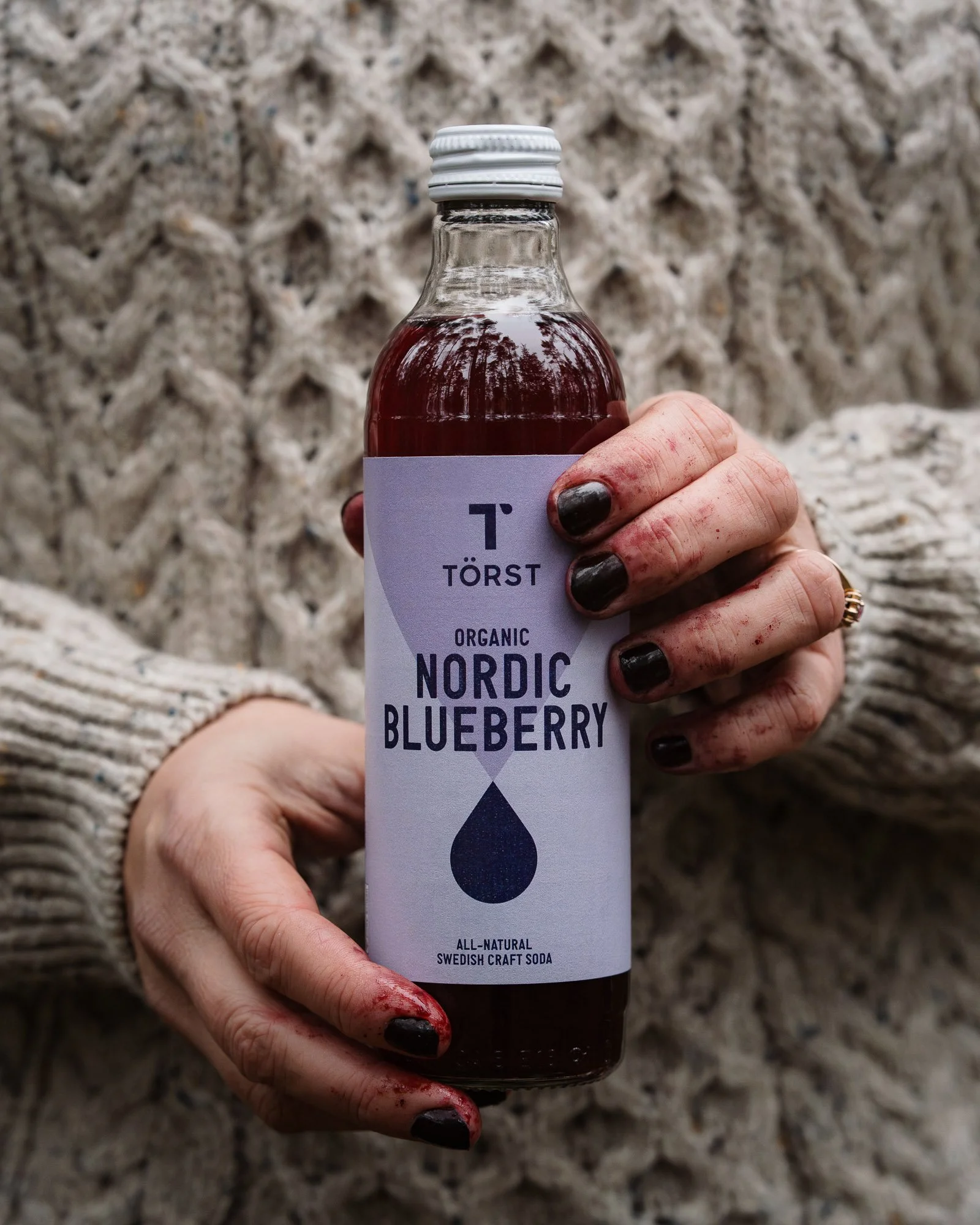
Nordic Blueberry drink, Törst.
Now, could AI create an image of a woman in a Swedish knitted jumper with blueberry stained hands holding a Nordic blueberry drink? Let’s see shall we. Here is the image AI created for me.
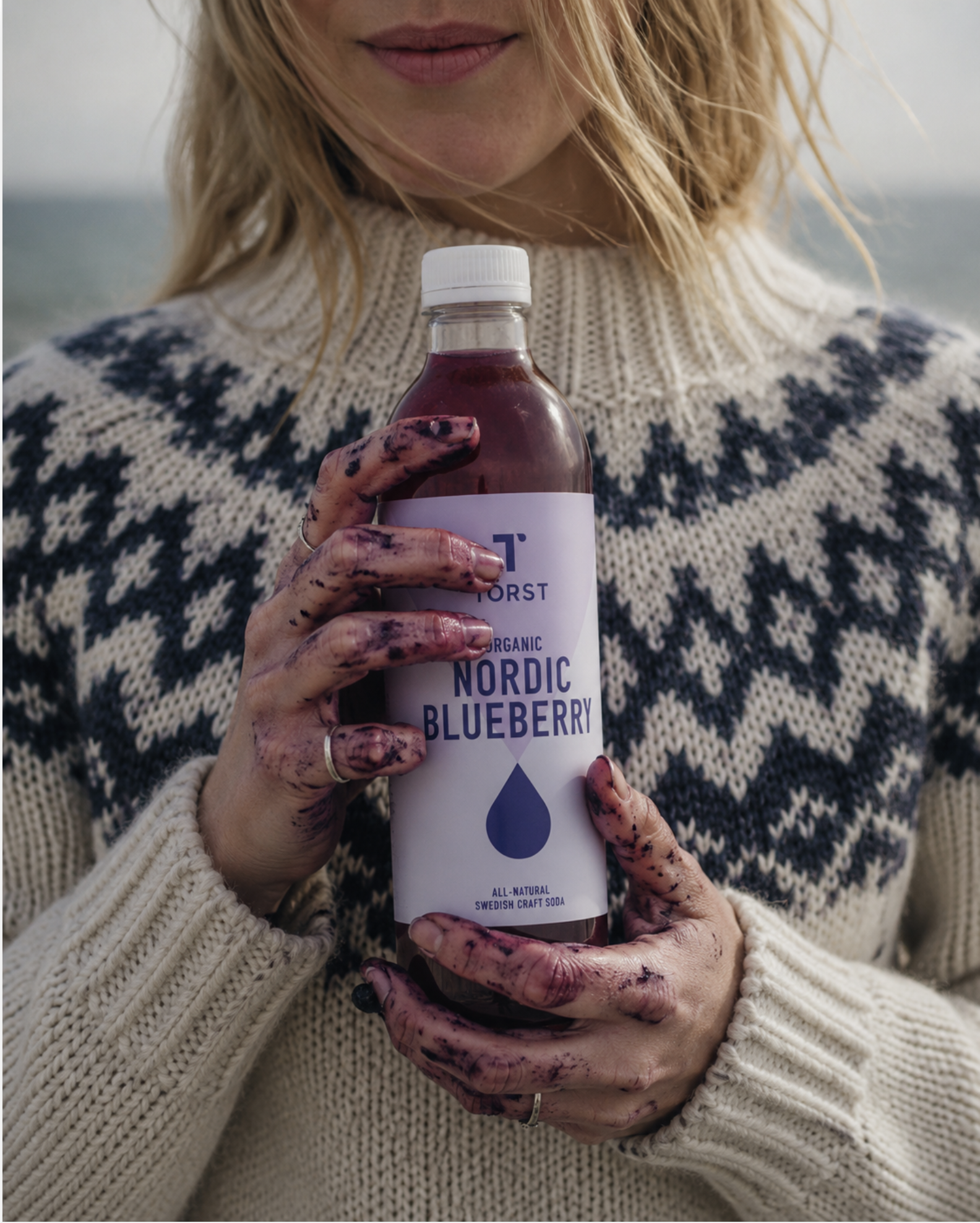
AI generated image of Törst Nordic Blueberry.
At first glance, it looks ok. There is a Nordic jumper, there are blueberry covered hands. There is a bottle of Törst Nordic Blueberry. The lighting is lovely. If you were scrolling quickly through Instagram, you might not immediately question it. But look again. One of her fingernails seems to have disappeared. The blueberry stains are not really the colour blueberries leave on skin. The bottle isn't the same shape as the actual Törst bottle, the lid isn't the right lid and even though I gave AI the real product as a reference, it has redesigned parts of it. And then there's the label. It's close, but it's not the real label. It has that strangely perfect, polished quality that makes the whole thing feel like a mock up of a product rather than a photograph of something you could actually pick up and drink. Individually, these things might sound tiny, but for a brand they are important details that should accurately represent the real product in a real situation. Your bottle shape is part of your product, your label is part of your brand identity Your logo, typography, colours, packaging and even the lid have all been chosen for a reason. You probably spent a considerable amount of time and money getting those things right. So why would you pay to advertise a slightly fictional version of them? In my photograph, the blueberries had actually been crushed into the model's hands. The colour caught differently around her fingernails, in the creases of her fingers and across her skin because that's what blueberries actually do. AI has understood the instruction, blueberry stained hands, but it hasn't really understood what blueberry stained hands actually look like. There's a difference, and I think that's exactly where the problem lies. AI is incredibly good at creating an approximation of an idea. But commercial brand photography isn't about creating something that's roughly right, If that image is advertising your product, the details matter. Now, of course, a skilled AI artist could fix all of these things. They could composite the real bottle back into the image, correct the hands, work on the label, fix the fingernail, adjust the colour, refine the lighting and retouch all the little details that give the game away. But now we are back to the question of cost, because that isn't a "press a button and get a cheap campaign." That's skilled creative work, and skilled creative work costs money, whether the person doing it is holding a camera, working in Photoshop or building an image using AI.
So should brands avoid AI completely?
No, I don't think that's realistic or particularly useful. AI is a tool, Photoshop is a tool, A camera is a tool, 35mm film is a tool. The interesting part is deciding which tool is right for the idea. I can see huge potential for AI in pre-production, mood boarding, concept development, extending backgrounds, creating elements that would be disproportionately expensive to produce practically and combining AI with real photography. but That is very different from replacing an entire brand library with artificial images because whether brands want to admit this or not, it appears cheaper. For me, the most interesting future probably isn't AI photography versus real photography, It's knowing where AI genuinely improves the creative process, and where it doesn't.